
Gold Coast sun sits at the top of the UV scale for most of the year, the water is salt, and the Coomera River carries silt. A motor yacht here loses her shine faster than almost anywhere in the country, which is why detailing is not a luxury line on the budget but the thing that decides what she looks like at survey and what she is worth at sale. Here is what the work involves, what each layer of protection really lasts, what the published prices are, and the wash-down routine our own crew run every week.
Key facts
- Wash — fresh rinse within 24 hours of every salt trip; full pH-neutral wash every two to four weeks
- Protection — wax two to three months; sealant six to twelve; professional ceramic 18 to 36 months with top-ups
- Prices — no Gold Coast detailer publishes rates; Sydney’s published card is $5 a foot to wash, $20 a foot to machine polish
- Ceramic — no Australian price published for a 40 to 90 ft yacht; the preparation is most of the cost
- Gelcoat or paint — gelcoat can be cut; Awlgrip and Alexseal cannot, or not much
- Teak — never sanded as routine; sealed, not oiled; re-coat when it stops beading
Why the Gold Coast is hard on a boat
- UV. The Bureau’s averages put January at UV 11 or higher over almost all of Australia, and Brisbane needs sun protection every month of the year. Gelcoat chalks, paint fades, clears yellow, and it happens faster on dark hulls.
- Salt. A wet berth means salt air around the clock. The stainless standard body puts tea staining as most likely within five kilometres of surf or a few hundred metres of still salt water, which describes every marina on the Coast.
- Silt. The Coomera River runs at up to 100 NTU of turbidity after floods and higher upstream. A boat in the Coomera precinct wears a brown line at the waterline that a Broadwater boat does not.
- Birds. Uric acid etches gelcoat within minutes in sun. Left for a week, the mark needs compounding out.
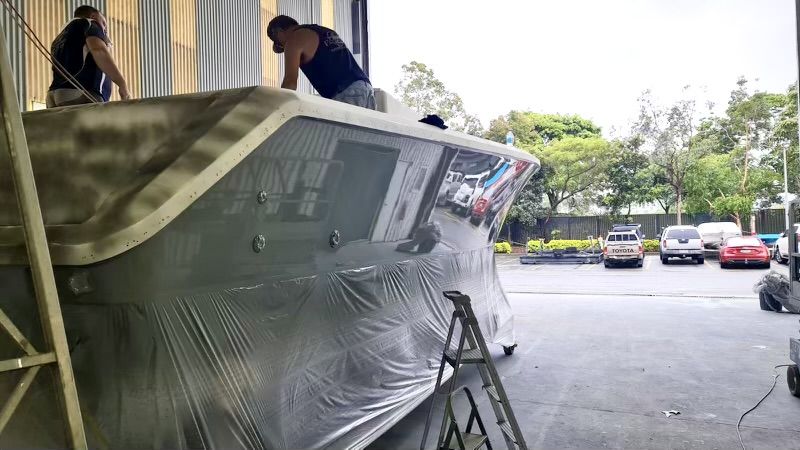
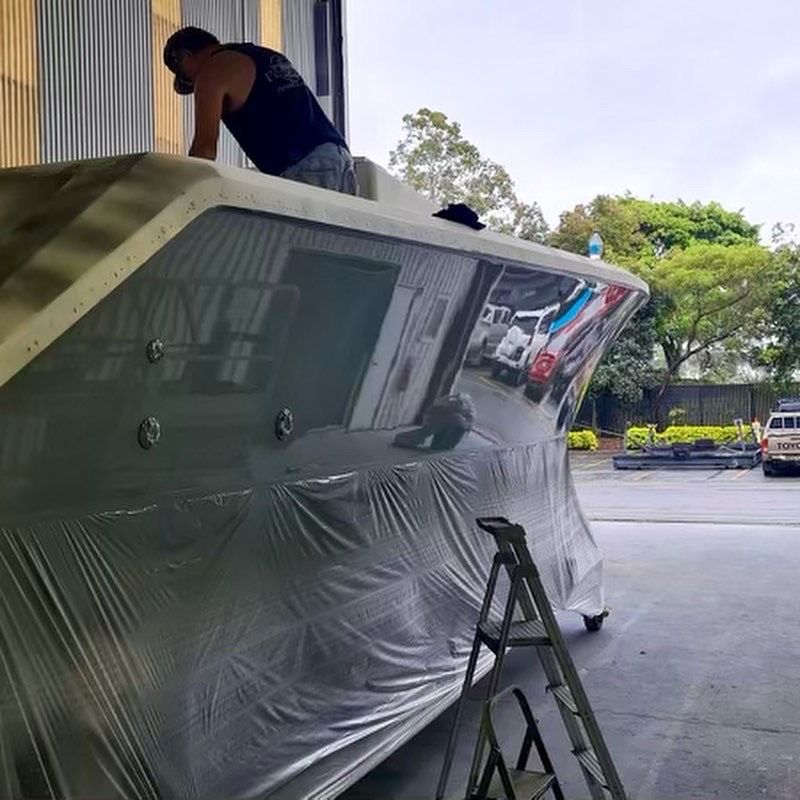
The wash-down: what a proper one includes
This is the Marine HQ crew routine, the one on the clipboard on every managed yacht. A wash-down is also our regular close-up inspection, which is why it ends with a report.
- Before you start. Check the wind and the sun; avoid a strong breeze or full hot sun. Remove covers and cushions and stow them dry. Open and air the lockers. Fresh shore water connected, pH-neutral boat soap only, dedicated cloths for glass and clears, every hatch and port closed. No harsh brushes on gelcoat, glass or clears.
- Rinse, top down. Flush the whole vessel with fresh water from the top before anything touches her. Salt and grit lifted off first are salt and grit not ground in.
- Wash section by section. Hardtop, flybridge and arch; superstructure and cabin sides; hull topsides and boot stripe. Work in shade, soft mitt or soft brush, rinse each section before it dries.
- Decks and non-skid. Soft deck brush and soap, rinse thoroughly, clear the scuppers and drains.
- Glass and clears. Glass with a dedicated cleaner and a clean cloth. Clears and isinglass with fresh water and a soft cloth only, no chemicals, no scrubbing. Windex, Rain-X and ammonia products void the clears' warranty.
- Stainless. Rinse and wipe every rail, fitting and cleat. Spot-polish and protect as required. Report any rust or corrosion.
- Teak. Rinse well. A light scrub across the grain only if needed, never aggressive, and protect the caulking.
- Chamois. Gelcoat, glass and stainless, to stop water spots, especially on dark surfaces and glass.
- Tender and aft deck. Rinse and wipe the tender, wash the cockpit and aft deck, check the drains.
- Covers, cushions, lockers. Refit once dry with ventilation underneath; wash covers where needed; clean and air lockers then secure them.
- Pack down. Hoses coiled, mops and mitts hung to dry, buckets rinsed, gear back where it lives.
- Finish and report. A final walk-around for damage, corrosion, leaks and loose fittings; any issue photographed and reported; the wash logged with date and crew.
How often: a fresh-water rinse within 24 hours of every salt trip, and a full wash every two to four weeks in season, more for a wet-berthed boat than a dry-stored one. Dry stacks stop at about 10 m, so for a 40 to 90 ft yacht the choice is a wet berth with a good routine, or a shed for the yard period.
Wax, sealant or ceramic
| Layer | Lasts | Cost, published | Upkeep |
|---|---|---|---|
| Wax | two to three months; one-step cleaner waxes about six | Sydney rate $3.50 a foot added to a wash on a 51 to 60 ft boat | Reapply every few months; easy, cheap, short |
| Polymer sealant | six to twelve months | Quoted with a polish | Re-coat two or three times a year on painted hulls |
| Ceramic, spray-on | three to six months | From $7.70 for a 50 mL bottle, applied after a wash | A maintenance layer, not a coating |
| Ceramic, professional | 18 to 36 months claimed; 30-month field tests still beading | No Australian price for a large yacht; jet skis from $650, trailer boats from $850 | pH-neutral washes only, no wax over it, booster spray every three to four months, annual inspection |
The manufacturers’ own numbers are the honest ones. Kovalent, the coating used by one Coomera applicator, says 24 to 36 months, with the three-to-five-year warranty conditional on maintenance by an approved applicator. Glidecoat says 18 months for its standard product and two years for its premium one, and its own 30-month Florida study showed gloss readings still between 50 and 85 with water beading. Gtechniq’s spray-on Fast Coat is rated at up to six months. Independent reviewers put professional ceramic at 18 to 24 months in southern-US conditions, which are the nearest thing to Queensland, with a touch-up rather than a full recoat each year.
Worth knowing
Ceramic is only as good as the preparation. The hull has to be stripped of every trace of wax, decontaminated, compounded and polished before the coating goes on, and any swirl or scratch left behind is locked in under it. That preparation is most of the job and most of the price. A ceramic quote that is cheaper than a cut and polish has skipped the cut and polish.
Ceramic Pro Australia’s own page says what the coating does not do: it does not remove the need for wash-downs, and it does not fully prevent salt, water spots or marine growth. What it does is make the wash faster, because salt and grime do not bond, and stretch the interval between machine polishes.
Gelcoat versus paint
Know which one your boat has before anyone picks up a buffer.
- Gelcoat is typically a quarter to one millimetre thick, nominally half. Light oxidation polishes out; medium needs compound then polish; heavy needs an extra-cut compound and sometimes wet-sanding first. The rule is the least aggressive product that works, because every cut takes gelcoat off and it does not grow back. Most boats need a full polish and wax at least yearly, more in this sun. After a first correction, an annual light cut is the norm.
- Awlgrip says do not use polishing compounds on its topcoat. Abrasives shorten the finish and void the warranty. Care is Awlwash and a fresh rinse; Awlcare polymer by hand to hold the shine until it is time to repaint. No traditional waxes, which yellow it.
- Alexseal allows a fresh rinse after every use, a weekly pH-neutral wash, a polymer sealer two or three times a year, and compounding only by an experienced applicator at slow speed. Aggressive buffing removes coating and shortens its life. Do not trap moisture under covers; it bubbles within days.
Painted boats are the ones where a cheap detailer does real damage. Paint has one shine; compound through it and the only fix is a repaint.
Teak, stainless and clears
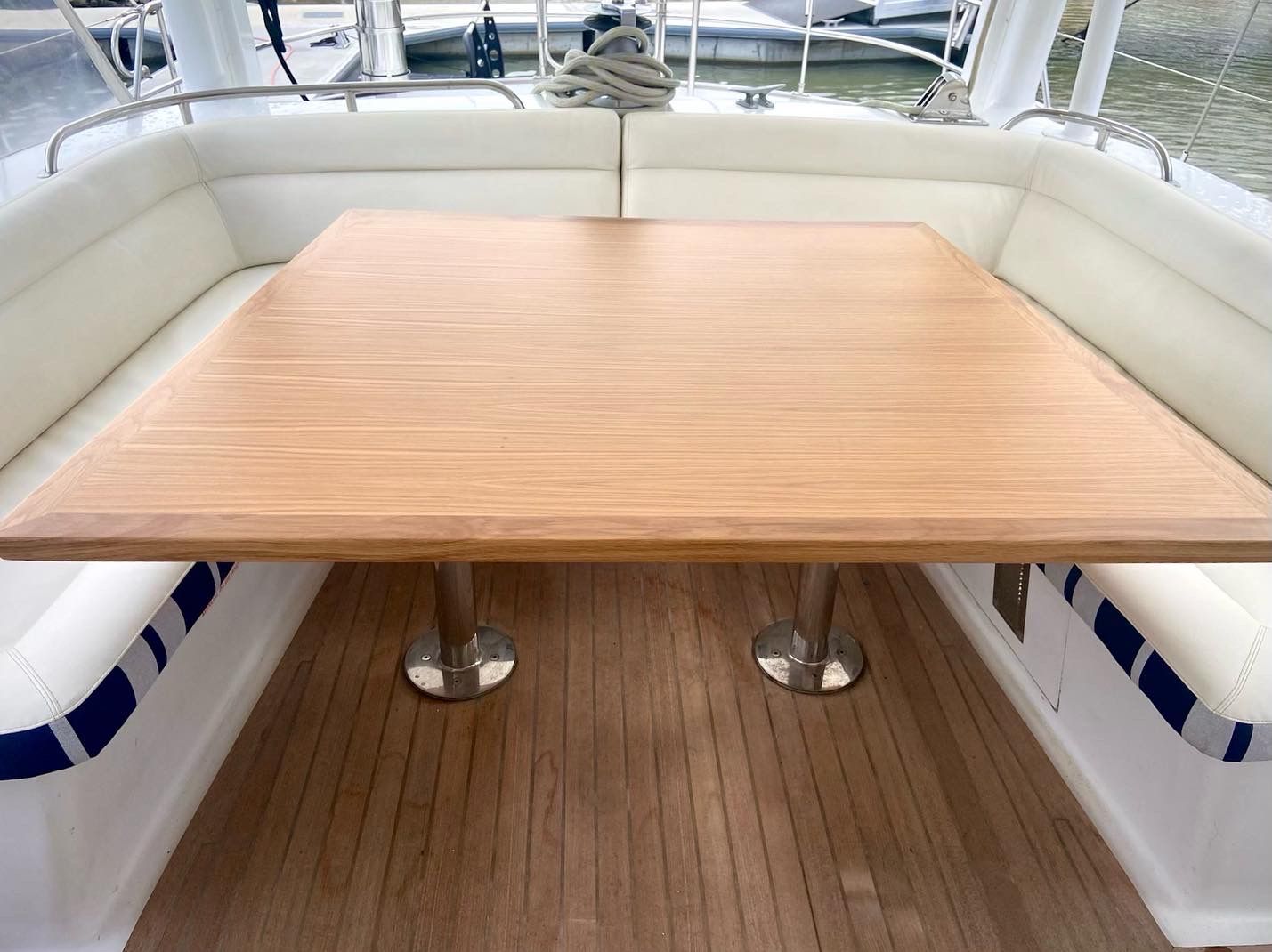
Teak. Rinse after salt, scrub gently across the grain with a soft or medium brush, deep clean once or twice a season. Two-part acid cleaners at most twice a year and only for a genuine restoration. Never sand as routine: decks are 8 to 10 mm thick with a 4 to 6 mm wearing layer and each sanding removes half a millimetre to a millimetre. Inspect the seams yearly; a full re-caulk is a professional job. Sealers outlast oils; Semco, the sealer several Coomera detailers use, is re-coated every three to six months in high exposure, or when the deck stops beading water.
Stainless. Fresh rinse after every use, soap monthly, a polish and protectant every three to six months, and passivation when tea staining starts to show. It is cosmetic, not structural, but it is the first thing a buyer sees.
Clears. Fresh water and a soft cloth. The manufacturers list the products that void the warranty: Windex, Rain-X, Pledge, Plexus, Simple Green and anything with ammonia.
What it costs
No Gold Coast detailer publishes a rate card. Short Marine, Gold Coast Antifouling, Sea Spray Marine, The Boat Butler, Gold Coast Mobile Boat Detailing, GC Marine Services and B&S Detailing all quote on inspection, and the sensible reason is that the condition of the boat decides the price more than her length does. The only Australian published rates are in Sydney.
| Job, 60 ft in reasonable condition | Published rate | Works out at |
|---|---|---|
| Detail wash | $5.00 a foot, Sydney | about $300 |
| Detail wash and wax | plus $3.50 a foot | about $510 |
| Machine polish, topsides and machine wax | $20 a foot for 51 to 55 ft; custom above | about $1,200 and up |
| Full exterior wash and polish, high-end Sydney provider | $90 a foot | about $5,400 |
| Ceramic coating | not published for a 60 ft yacht in Australia | ask for the preparation and the coating as separate lines |
Heavy oxidation, mould, perished clears and gelcoat that needs cutting are quoted separately everywhere. For budgeting, a fortnightly wash on a 60-footer at the Sydney rate is around $7,800 a year, which is the figure in our cost-of-ownership guide.
The rules
Queensland’s Environmental Protection Act makes everyone responsible for keeping contaminants out of the water and the stormwater. The guidance is to wash where the water is collected and treated, to use water alone where you can, and to choose biodegradable, phosphate-free products. Gold Coast City Marina runs treatment and recycling plants for its wash-down water and holds a Level 3 Clean Marina rating, which is why owners and contractors go through an induction there. In-water hull cleaning needs separate state approval.
What to check before you pay for it
- The quote names the products: soap, compound, polish, wax or coating, by brand.
- For a cut and polish, the detailer knows whether the hull is gelcoat or paint, and says so.
- For ceramic, the preparation is priced as its own line, with the days on the hardstand and the aftercare written down.
- Clears are cleaned with water only, and the detailer can say which products they will never use on them.
- Teak is cleaned, not sanded, unless you have asked for a restoration.
- Every visit ends with a report, or at least a photo of anything found.
What we do
Marine HQ crews wash managed yachts on a schedule, weekly or fortnightly depending on use and berth, with the routine above and a photograph of anything they find, into the owner’s MyYacht app. Cut and polish, teak, stainless and ceramic are scoped into the annual haul-out where the hull is at the right height and out of the sun. If she has gone dull, or you want her kept the way she was delivered, call 0439 748 387 or email yachtsupport@marinehq.com.au.